Research
Project Findings
The project developed new mathematical tools for understanding how ordered light waves become turbulent in nonlinear optical systems. Its main model was the Schrödinger–Helmholtz equation, which describes spatially nonlocal optical media and connects idealised nonlinear-wave theory to systems such as optical fibres and photorefractive liquid crystals.
The work combined wave turbulence theory with the study of coherent structures such as solitons and optical vortices. This produced descriptions of weak turbulence in one- and two-dimensional systems, alongside new results about the interactions that drive stronger turbulent states.
Key Outcomes
- Reduced theories of optical wave turbulence - Semi-local kinetic models were developed for both one- and two-dimensional systems. These models predict how wave action is transferred across scales and provide a practical framework for studying nonlocal optical turbulence.
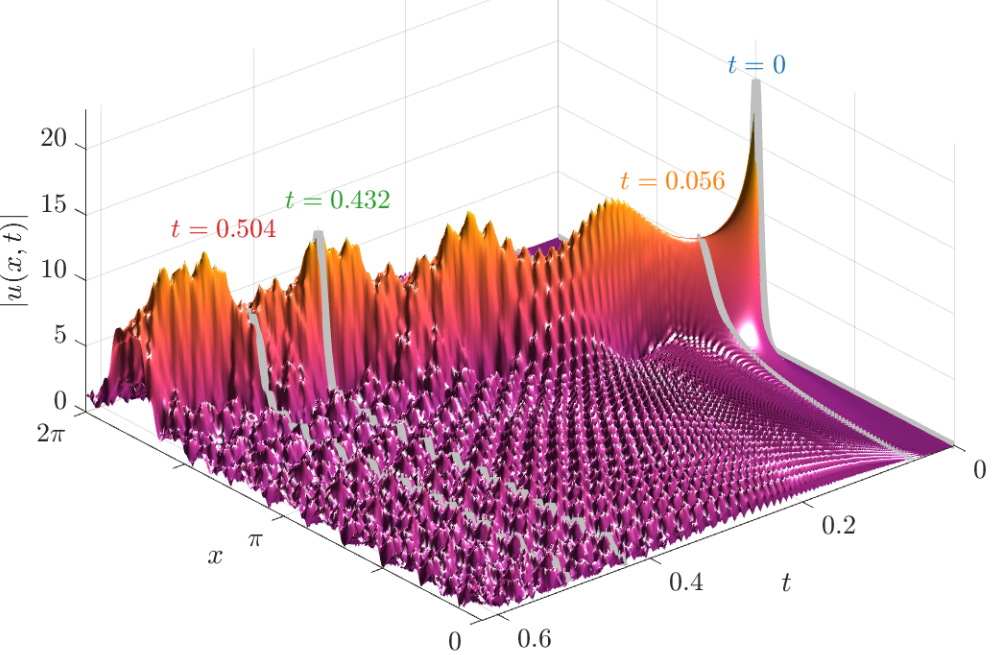
- Soliton interactions and bound states - Strong one-dimensional turbulence was found to approach an oscillating bound state containing multiple soliton signatures rather than a single dominant soliton. Soliton mergers are promoted when their phases align and inhibited when their phases are out of sync.
- Optical-vortex dynamics - The point-vortex model was derived from the two-dimensional nonlinear Schrödinger equation using a Hamiltonian approach. Subsequent work characterised vortex dipole scattering, cluster disruption, and mechanisms capable of producing topological changes in two-dimensional flows.
- Soliton stability and bifurcations - Numerical methods were developed to locate and test coherent stationary states. The calculations identified two distinct families of soliton solutions, providing a basis for continued work on sequential bifurcations.
- Wider applications - Although motivated by nonlinear optics, the methods may also inform models of Bose–Einstein condensates, quantum-vortex waves, and nonlocal models of dark matter.
Published Journal Articles
- K. Lydon, S. Nazarenko and J. Laurie, Dipole Dynamics in the Point Vortex Model, J. Phys. A, 55, 385702, (2022).
 10.1088/1751-8121/ac89bc
  :2112.13365
 - J. Skipp, J. Laurie and S. Nazarenko, Hamiltonian Derivation of the Point Vortex Model from the Two-Dimensional Nonlinear Schrödinger Equation, Phys. Rev. E, 107, 025107, (2023). 10.1103/PhysRevE.107.025107 :2208.10412
- J. Skipp, J. Laurie and S. Nazarenko, An Effective Semilocal Model for Wave Turbulence in 2D Nonlinear Optics, Proc. R. Soc. A, 479, 20230162, (2023). 10.1098/rspa.2023.0162 :2304.13547
- C. Colléaux, J. Skipp, S. Nazarenko and J. Laurie, A Bound State Attractor in Optical Turbulence, Physica D, 477, 134687, (2025). 10.1016/j.physd.2025.134687 :2410.12507
Preprint
- C. Colléaux, J. Skipp, J. Laurie and S. Nazarenko, Semi-Local One-Dimensional Optical Wave Turbulence (2024). :2412.14153